We deployed AI to do more with less.
So why are so many professionals ending the workday feeling like they've been hit by a cognitive freight train?
Harvard Business Review researchers have a name for it now: "AI Brain Fry”, and it all has to do with how we deploy the AI itself.
The Problem in Simple Terms
Picture a typical knowledge worker in 2026. They open their laptop and immediately begin managing five AI tools simultaneously: one drafting content, one synthesizing research, one generating code, one summarizing meeting notes, and one tracking outputs from the other four.
Instead of doing less work, now they are actually doing all sorts of different, harder work that snowballs into a worse working experience with AI.
A Harvard Business Review analysis surveyed full-time U.S. employees at large enterprises and found a pattern playing out across industries: workers managing clusters of AI agents experience a distinct form of mental fatigue characterized by a "buzzing" sensation, persistent mental fog, difficulty focusing, slower decision-making, and headaches after extended periods of AI oversight.
The researchers gave it a clinical definition: AI Brain Fry is mental fatigue caused by excessive use or oversight of AI tools beyond a person's cognitive capacity. And the irony of it all is that the organizations experiencing it the most are the ones that invested most heavily in AI adoption.
What the Data Actually Shows
The HBR research surfaced several findings worth pausing on:
More tools actively reduce productivity. Using a small, curated set of AI tools aligned with measurable productivity gains. But adding tools past a certain threshold reversed those gains entirely. This reflects well-established limits on multitasking and sustained attention - limits that don't disappear just because the tools are intelligent.
The roles feeling it most are the ones doing the most. Marketing professionals reported the highest prevalence of AI-related mental fatigue, followed by People Operations, Operations, Engineering, Finance, and IT. Legal teams reported the lowest, largely because lawyers maintain a healthy skepticism toward AI outputs and haven't adopted as aggressively.
The business costs are measurable. Workers experiencing AI Brain Fry reported higher rates of decision fatigue, increased frequency of both minor and major errors, and a greater likelihood of leaving their jobs. Critically, the employees most affected tend to be an organization's most capable AI adopters: the high-performance talent pools organizations are most invested in retaining.
The fix isn't more tools or better tools. It's fewer tools, applied to the right tasks. Workers who used AI to offload routine and repetitive work reported significantly lower burnout and more cognitive bandwidth for creative and strategic thinking. That's the version of AI productivity we were all promised.
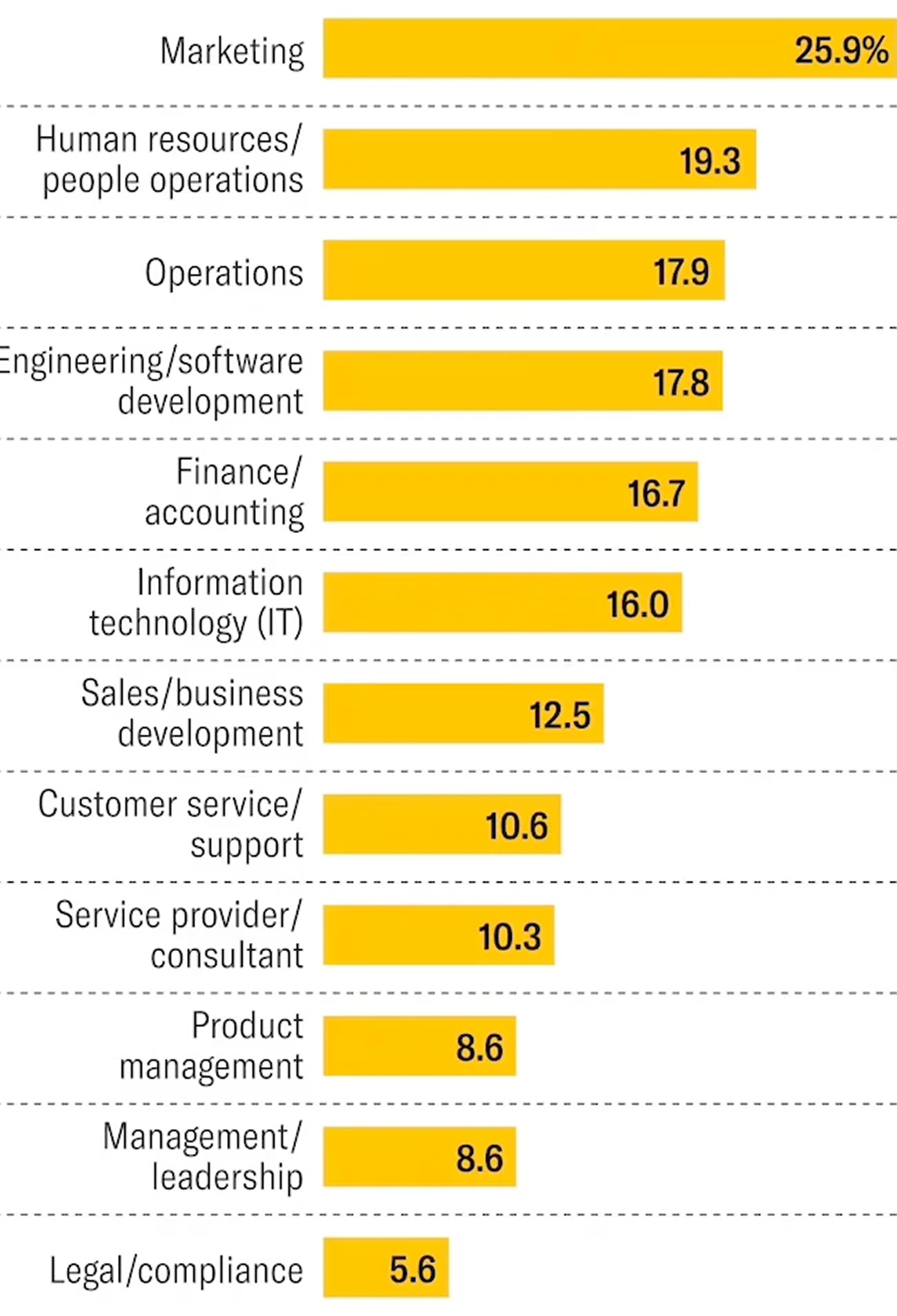
Employee-reported Al brain fry, by industry role (Source: Harvard Business Review)
What This Means for You
The challenge looks different depending on where you sit.
If you're an individual contributor actively using AI, it's worth auditing not just your outputs but your cognitive load. If you're ending the day mentally foggy despite high activity metrics, you may be experiencing AI Brain Fry. The question to ask is simple: which tools reduce effort, and which tools create meta-work? Cut the latter without guilt.
If you're a team leader or manager, the HBR data carries a direct warning. Your most engaged AI adopters are your most at-risk employees. If your performance systems reward AI output volume, token consumption, or activity metrics, you may be inadvertently burning out your strongest people. The research found that employees reported measurably less strain when managers engaged directly with AI-related challenges, when teams integrated AI into shared workflows, and when organizational culture signaled that work-life balance was genuinely valued.
If you're a decision-maker or CTO evaluating enterprise AI strategy, the implications are structural. Tool proliferation is not a strategy. Cognitive load is now a legitimate operational risk, and organizations that don't measure it will feel the effects in error rates, decision quality, and attrition long before they identify the cause.
Why This Research Validates a Different Approach
At Praxis AI, we've been building against exactly this problem since the beginning.
AI Brain Fry is what happens when AI is layered on top of existing workflows as a tool stack, requiring humans to verify, manage, and orchestrate multiple interfaces simultaneously. The cognitive debt compounds with every new tool added.
Our approach is different. Praxis AI Digital Twins consolidate institutional knowledge into a single, coherent expert voice, trained on curated content and secured within a patent-pending IP Vault. Users don't manage five tools. They interact with one expert who actually knows their context. The oversight burden disappears because the AI is trustworthy by design, not by constant verification.
The results reflect this: 55% engagement boost and 35% learning improvement at Per Scholas, and an 87% increase in teacher engagement at the NCAA. These outcomes don't happen when AI increases cognitive load. They happen when AI genuinely reduces it.
Even prior to this research, our goal has always been better AI: expertise that arrives with context, trust, and without the cognitive cost of managing a dozen competing interfaces.
The Bottom Line
The conversation around AI productivity has focused almost entirely on capability: what AI can do. The HBR research redirects our attention to a more important question: what AI adoption costs in human cognitive terms, and whether organizations are equipped to measure it.
The answer, for most enterprises today, is that they are not. And the employees most harmed by that gap are the ones most committed to making AI work.
Read the original research coverage: More AI Tools, More Burnout! New Research Explains Why by Anamarija Pogorelec, Managing Editor, Help Net Security (March 9, 2026), reporting on Harvard Business Review analysis of AI workplace fatigue.